
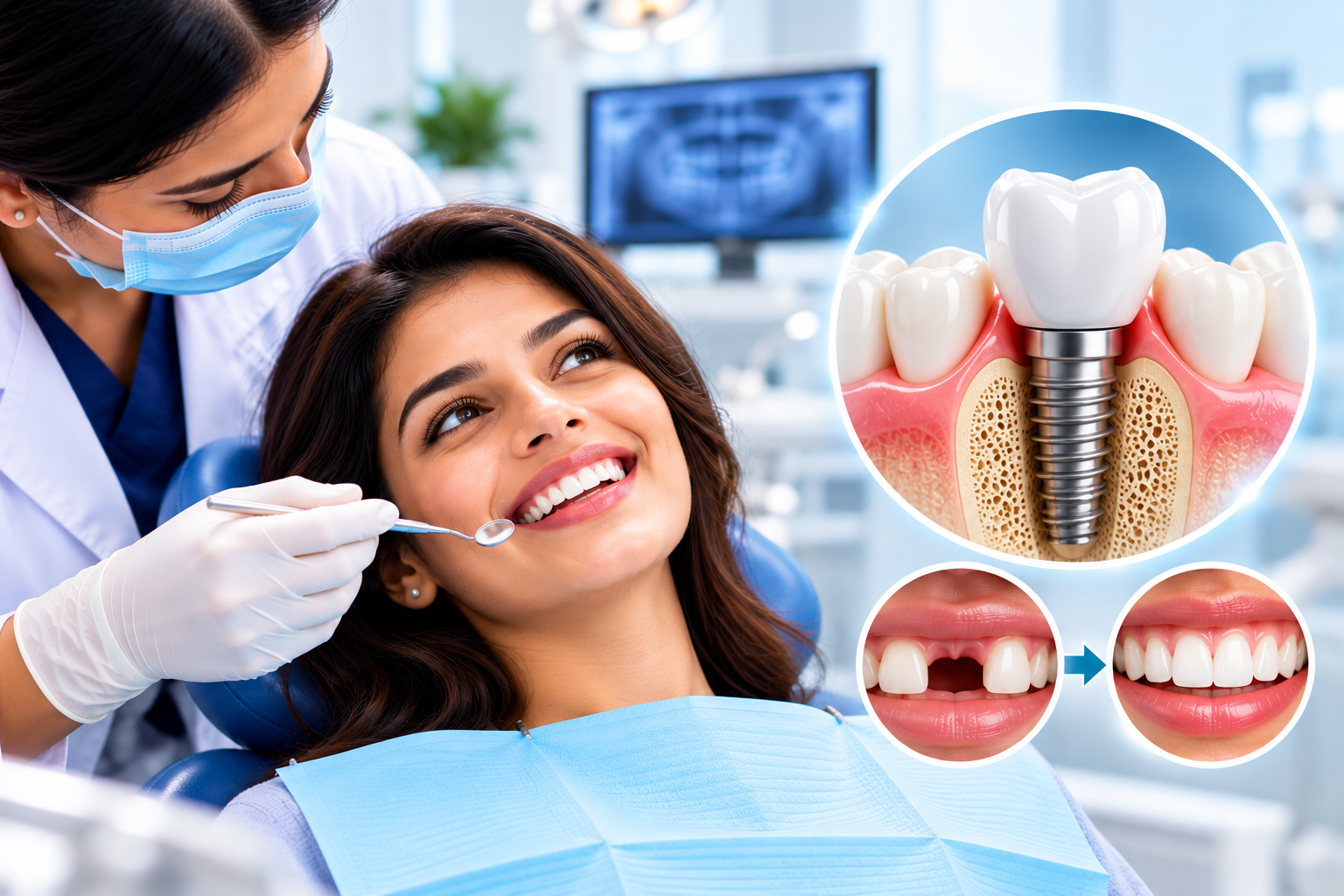

What Are Dental Implants?
Dental implants are a modern and long-lasting solution for replacing missing teeth. They consist of a small titanium post that is surgically placed into the jawbone to act as an artificial tooth root. Once the implant integrates with the bone, it supports a custom-made dental crown, bridge, or denture, restoring the appearance, function, and strength of natural teeth. Dental implants help improve chewing ability, speech, facial aesthetics, and overall oral health while preventing jawbone loss caused by missing teeth.
The Role of Dental Implants in Restoring Your Smile
Dental implants play an important role in restoring both the function and appearance of your smile. Unlike removable dentures, implants are securely fixed in the jawbone, providing excellent stability and comfort. They help preserve the jawbone, prevent neighboring teeth from shifting, and maintain the natural shape of the face. With proper care, dental implants can provide a durable and reliable tooth replacement solution for many years.
Dental Implant Services Offered at Our Dental Clinic in Kochi
Single Tooth Dental Implant
A single dental implant is the ideal solution for replacing one missing tooth without affecting the neighboring healthy teeth. The implant functions like a natural tooth root and supports a custom-made crown.
Key Points:
- Replaces a single missing tooth
- Preserves adjacent healthy teeth
- Natural appearance and function
- Prevents jawbone deterioration
- Long-lasting tooth replacement
Multiple Teeth Dental Implants
Multiple dental implants are used to replace two or more missing teeth. Depending on the condition of your mouth, implants can support individual crowns or a dental bridge.
Key Points:
- Replaces multiple missing teeth
- Improved chewing efficiency
- Stable and comfortable restoration
- Prevents shifting of nearby teeth
- Restores natural smile aesthetics
Full Mouth Dental Implants
Full mouth dental implants are recommended for patients who have lost most or all of their teeth. Implant-supported fixed prostheses provide a stable and permanent alternative to conventional dentures.
Key Points:
- Complete smile restoration
- Permanent replacement for missing teeth
- Improved speech and chewing ability
- Greater comfort than removable dentures
- Long-term oral rehabilitation
Implant-Supported Dentures
Implant-supported dentures are secured using dental implants instead of resting solely on the gums. They offer improved stability and reduce movement while eating and speaking.
Key Points:
- Better denture stability
- Reduced slipping and discomfort
- Improved chewing performance
- Increased confidence
- Comfortable fit
Bone Grafting for Dental Implants
Bone grafting is performed when there is insufficient jawbone to support a dental implant. The procedure rebuilds the bone, creating a strong foundation for successful implant placement.
Key Points:
- Rebuilds lost jawbone
- Improves implant success
- Enhances implant stability
- Supports long-term results
- Suitable for patients with bone loss
Sinus Lift Procedure
A sinus lift is performed when additional bone height is needed in the upper jaw before placing dental implants. This procedure increases bone volume beneath the sinus cavity.
Key Points:
- Creates adequate bone support
- Enables implant placement in the upper jaw
- Improves implant stability
- Safe and predictable procedure
- Increases treatment success\
Immediate Dental Implants
Immediate dental implants are placed soon after tooth extraction in suitable cases, reducing treatment time while preserving bone and gum tissue.
Key Points:
- Faster tooth replacement
- Reduced treatment duration
- Preserves jawbone
- Maintains gum appearance
- Convenient treatment option
Benefits of Dental Implants
Dental implants provide a permanent and natural-looking solution for replacing missing teeth. They restore normal chewing and speaking ability while preserving jawbone health and facial appearance. Unlike removable dentures, implants remain securely fixed and require no adhesives.
Benefits include:
- Permanent replacement for missing teeth
- Natural appearance and feel
- Improved chewing efficiency
- Better speech clarity
- Preservation of jawbone
- Prevention of bone loss
- Maintains facial structure
- Protects neighboring teeth
- Comfortable and stable solution
- Long-lasting results
- Easy maintenance
- Improved self-confidence
- Better overall oral health
- Supports healthy bite alignment
Common Problems That Can Be Treated with Dental Implants
Dental implants are recommended for patients experiencing tooth loss due to various reasons.
They can effectively restore:
- Single missing tooth
- Multiple missing teeth
- Complete tooth loss
- Tooth loss due to injury
- Tooth loss caused by decay
- Missing teeth from gum disease
- Loose dentures
- Difficulty chewing
- Poor smile aesthetics
- Jawbone deterioration after tooth loss
How Do Dental Implants Differ from Other Tooth Replacement Options?
Dental implants differ from traditional bridges and removable dentures because they replace both the missing tooth and its root. Unlike bridges, implants do not require the support or alteration of neighboring healthy teeth. Compared to removable dentures, implants provide greater stability, improved comfort, and better chewing function. They also help preserve the jawbone, making them one of the most effective long-term tooth replacement solutions available.
When Should You Consider Dental Implants?
You should consider dental implants if you have one or more missing teeth, difficulty chewing, loose dentures, or wish to restore your smile with a long-lasting solution. Dental implants are also suitable for individuals with healthy gums and adequate jawbone support. A detailed dental evaluation helps determine whether implant treatment is the right option for your oral health needs.
Advanced Procedures in Dental Implant Treatment
- Digital Implant Planning – Advanced digital imaging is used to precisely plan implant placement for safe and predictable results.
- Immediate Implant Placement – Dental implants are placed immediately after tooth extraction whenever suitable.
- Bone Grafting Procedures – Bone grafting strengthens the jawbone to support successful implant placement.
- Implant-Supported Crowns – Natural-looking crowns are securely attached to implants for restoring individual missing teeth.
- Implant-Supported Bridges – Multiple missing teeth are restored using implant-supported bridges.
- Implant-Supported Full Mouth Rehabilitation – Restores an entire arch of missing teeth using strategically placed dental implants.
- 3D CBCT Imaging for Implant Planning – Three-dimensional imaging provides detailed evaluation of bone quality and anatomical structures.
- Customized Prosthetic Restorations – Individually designed crowns, bridges, and dentures ensure optimal function and aesthetics.
Why Dental Implants Are Important for Your Overall Oral Health
Dental implants do more than replace missing teeth—they help preserve jawbone density, maintain facial structure, and prevent neighboring teeth from shifting. They restore proper chewing and speech, making everyday activities more comfortable. By replacing missing teeth with a stable and durable solution, dental implants contribute to long-term oral health, improved confidence, and a better quality of life.
Frequently Asked Questions (FAQ’s)
1. What are dental implants?
Dental implants are titanium posts placed into the jawbone to replace missing tooth roots and support artificial teeth.
2. Are dental implants permanent?
With proper care and regular dental checkups, dental implants can last for many years and are considered a long-term tooth replacement solution.
3. Is dental implant treatment painful?
The procedure is performed under local anesthesia, making it comfortable. Mild discomfort after surgery usually subsides within a few days.
4. Who is a suitable candidate for dental implants?
Most adults with healthy gums and sufficient jawbone are suitable candidates. A dental examination is required to determine eligibility.
5. How long does dental implant treatment take?
Treatment duration varies depending on individual needs, bone healing, and whether additional procedures such as bone grafting are required.